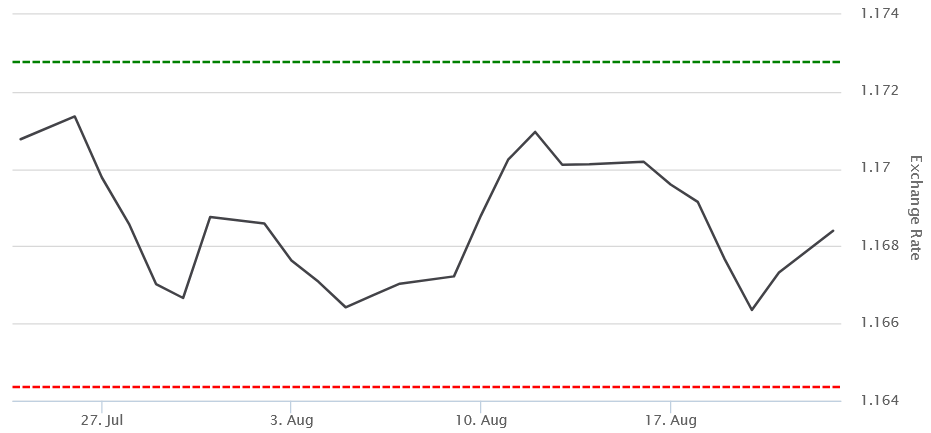
The pound is managing to hold on to its summertime gains on both the euro and US dollar. However, just when markets might have hoped for a quieter end to August, Donald Trump has provided another reason to keep an eye on North America. Trade talks between the US and Canada collapsed over the weekend, allowing new American tariffs on billions of dollars of Canadian goods to take effect. Ottawa has promised to respond in kind next month.
The dispute matters well beyond the Canadian dollar. Canada and the US have one of the world’s largest trading relationships, with supply chains crossing the border several times before a finished product reaches the customer. Fresh tariffs raise the prospect of higher costs for American firms and consumers, and this could have an impact on US interest rates, and our own.
That brings us neatly to the other big story of the week. Fed chairKevin Warsh will make his first Jackson Hole keynote on Friday. Investors want some clarity after a difficult spell for US government borrowing and growing questions over how the Fed intends to communicate its next steps. The gathering itself begins on Thursday, with Warsh speaking the following day.
Currency markets were relatively restrained before the weekend. Sterling finished Friday slightly stronger against both the euro and US dollar, while the euro also made modest progress against the dollar. The question now is whether another trade dispute adds to the pressure on the greenback or instead sends investors towards the traditional safety of the world’s reserve currency.
There is not much UK data arriving today to settle that argument. Instead, attention will remain fixed on the fallout from the US-Canada row and the build-up to Jackson Hole. Later in the week, American inflation figures and European confidence data should add some harder economics to a week that has begun with politics firmly in charge.
Sterling ended last week with some momentum, but Monday offers few obvious domestic catalysts. That leaves the pound more exposed than usual to developments elsewhere, particularly shifts in expectations for US interest rates and the wider market response to the latest trade escalation. The domestic picture remains mixed. Recent UK figures have shown firmer growth alongside higher inflation and unemployment, leaving the Bank of England with plenty to weigh up. For now, however, the pound’s immediate direction may have more to do with events in Washington and Wyoming than Westminster.
EUR: Consumers offer a little encouragement
There was a modestly brighter signal from eurozone households before the weekend. The European Commission’s latest survey showed consumer confidence edging higher in August, although it remains below its long-run average. The ECB’s own survey told a similar story. Inflation expectations eased slightly and households became a little less gloomy about the economic outlook. That is hardly a boom, but it gives the euro a different sort of support after months in which energy prices and geopolitical uncertainty have dominated the conversation.
USD: Trade fight complicates Warsh’s week
Kevin Warsh probably did not need another complication before his first Jackson Hole address. The new tariffs on Canadian goods risk adding to prices at the same time as investors are already debating whether US inflation is cooling quickly enough to give the Fed more room on interest rates. That makes Friday’s speech particularly important for the dollar. Markets will be listening less for a firm promise on the next rate decision and more for clues about how Warsh sees the balance between inflation, softer economic signals and financial-market strains. Before then, every fresh piece of US data – and every development in the trade dispute – has the potential to reshape that debate.
Below you will find the current live exchange rates and movements in the currency markets. Please note that these rates are only accurate at the time of sending and should be used as an indication only.