Half of tenant maintenance reports arrive outside office hours, summer data reveals
15 September 2026
Nearly three-quarters of hot-water disruption reports are raised out of hours, while plumbing remains the most common maintenance issue
14 September 2026 - UK: Half of tenant property maintenance cases are first reported outside traditional office hours, according to new analysis of rental maintenance activity over the summer.
The findings were compiled from Lettie’s property maintenance database, which supports over 10,000 tenants, with the analysis focusing on maintenance issues reported between 1 June and 31 August 2026.
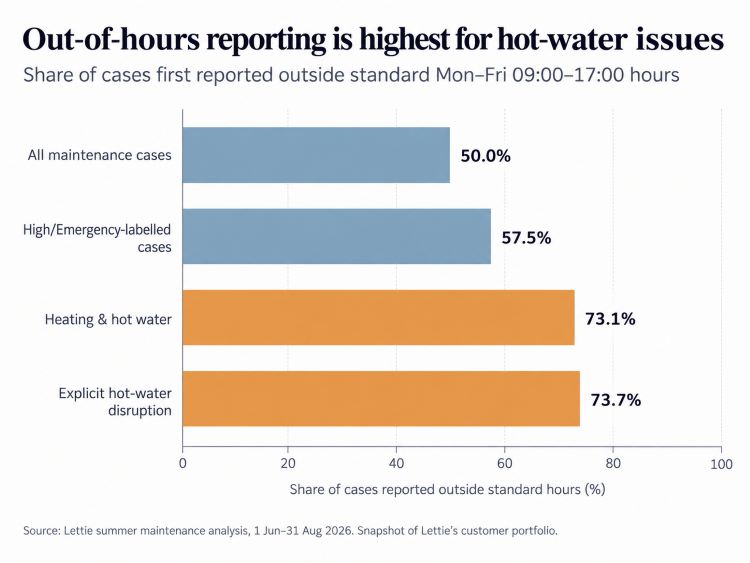
The data shows that 50.0% of maintenance cases were first logged outside Monday-to-Friday, 9am-to-5pm working hours, while 17.4% were first reported at weekends.
The figures highlight the extent to which tenant maintenance demand now sits outside the conventional working day - particularly when essential services are affected.
Nearly three-quarters of hot-water problems reported out of hours
Heating and hot-water cases showed one of the strongest out-of-hours patterns in the analysis.
73.1% of heating and hot-water cases were first reported outside standard working hours.
Looking specifically at reports involving an explicit loss or disruption of hot water, that figure increased to 73.7%.
The findings suggest that some of the maintenance problems most disruptive to tenants are also among those most likely to be raised when property management offices are traditionally closed.
Higher-priority issues followed a similar pattern.
Among cases carrying a High or Emergency label, 57.5% were first reported outside standard weekday hours.
Connor Hawkins, Chief Solutions Officer at Lettie, said:
“Anyone working in property management knows that maintenance does not stop at 5pm, but the scale of the out-of-hours demand is striking.
“When half of maintenance cases are first reported outside the traditional working day - and almost three-quarters of hot-water disruptions arrive out of hours - this cannot really be treated as an occasional exception.
“For landlords and letting agents, the challenge is having an effective way to capture the problem, understand its urgency and decide what needs to happen next, regardless of when the tenant reports it.”
Plumbing is the most common summer maintenance problem
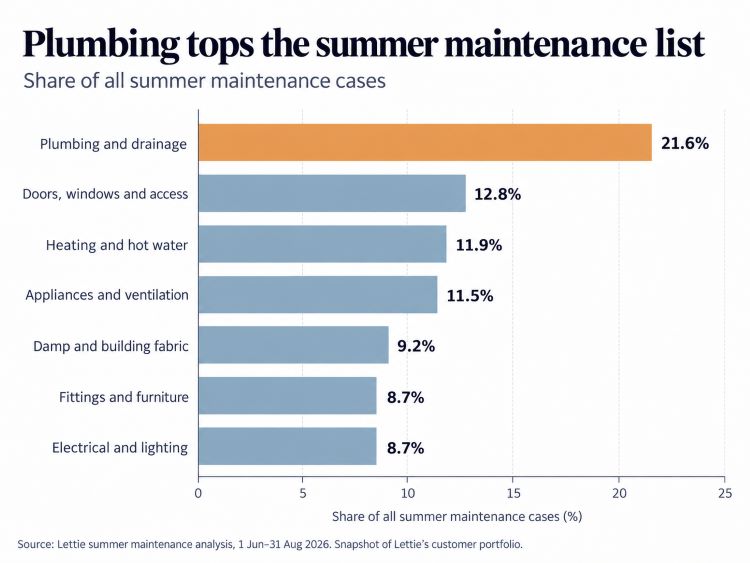
Plumbing and drainage accounted for 21.6% of all cases, making it the largest individual maintenance category in the summer sample.
It was followed by doors, windows and access at 12.8%, heating and hot water at 11.9%, and appliances and ventilation at 11.5%.
Damp and building fabric represented 9.2%, while fittings and furniture and electrical and lighting each accounted for 8.7%.
Taken together, plumbing and drainage plus heating and hot water accounted for 33.5% of all cases.
The findings underline how much of the day-to-day maintenance workload is concentrated around services that can have an immediate impact on a tenant’s use of their home.
More than one in eight cases showed evidence of a previous problem
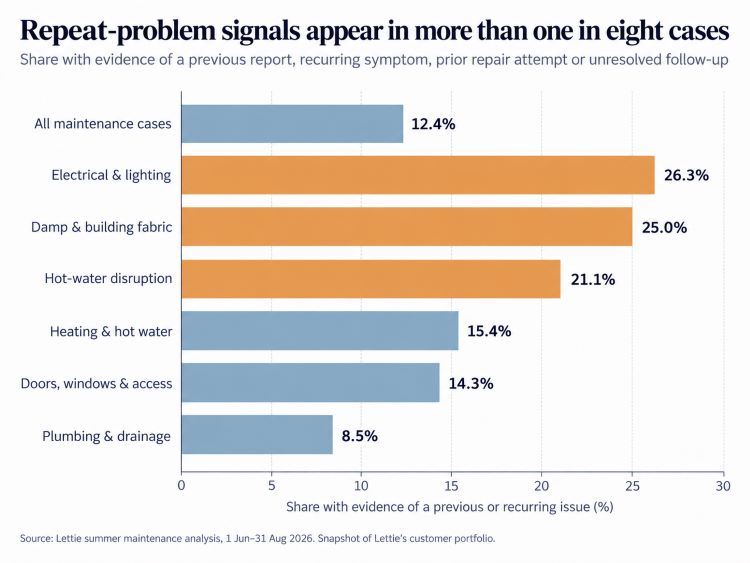
The analysis also found that at least 12.4% of cases contained evidence of a previous report, recurring symptoms, a prior repair attempt or an unresolved follow-up.
The proportion was higher in several maintenance categories.
26.3% of electrical and lighting cases showed evidence of a previous or recurring concern, alongside 25.0% of damp and building-fabric cases.
For heating and hot water the figure was 15.4%, while 21.1% of cases specifically involving hot-water disruption showed evidence of a previous or recurring issue.
The figure should not be interpreted as a contractor failure rate, but it does demonstrate the importance of understanding the history behind a maintenance report rather than treating every new contact as an isolated incident.
Connor Hawkins, Chief Solutions Officer at Lettie, added:
“The data also shows why maintenance is about more than simply receiving a message and arranging a repair.
“A meaningful proportion of issues have some previous history attached to them. Understanding whether something has happened before, whether an earlier repair was attempted or whether symptoms are recurring can materially affect what the right next step should be.
“As property portfolios become larger, maintaining that context becomes increasingly important.”
A growing operational challenge for the rental sector
The summer figures point to a broader challenge for landlords and letting agents: maintenance demand is often unpredictable, frequently arrives outside office hours and can involve issues with an existing history.
The data suggests that out-of-hours reporting is not confined to low-priority problems. Instead, some of the issues most likely to affect a tenant’s immediate use of their property are among the most heavily weighted towards evenings, nights and weekends.
For property managers, that makes the ability to capture, assess and prioritise maintenance information outside the traditional working day an increasingly important part of managing rental homes effectively.


